
The Hidden Danger of Asbestos: Why Training is No Longer Optional
In 2026, asbestos is not just a legacy hazard, it’s still a real and ongoing threat in workplaces across the United States. The Asbestos Disease Awareness Organization states that in June 2026, the U.S. Court of Appeals for the Fifth Circuit will hear a major case, Texas Chemistry Council v. EPA, which challenges the Environmental Protection Agency’s authority to regulate chrysotile asbestos under the Toxic Substances Control Act (TSCA). This case is especially significant because the same court previously overturned a nationwide asbestos ban in 1989, but updated laws now require stronger, science-based protections.
Despite decades of research, regulation, and legal battles, one key concern remains. In 2026, asbestos remains a serious workplace hazard, and public health organizations widely recognize that there is no safe level of exposure. This isn’t just a regulatory statement; it’s a scientific reality backed by decades of medical research and legal advocacy. This highlights the importance of proper training, such as NATEC’s Asbestos Training Programs.
The Reality: Asbestos Is Still Killing Workers
The Asbestos Disease Awareness Organization’s Article shows that there is need to continue to push for stronger protection backed by science, because the risks have never gone away and they are still very real.
- Asbestos is a well-known human carcinogen. Exposure from asbestos can lead to:
- Lung Cancer
- Mesothelioma
- Asbestosis
One major concern is that these diseases often take 10–50 years to appear, making early exposure especially dangerous. Even more alarming, thousands of Americans still die each year from preventable asbestos-related diseases. This is why prevention, not reaction, is the only real solution.
Where the Danger Still Exists
Many people assume asbestos is banned or no longer a concern, but that is far from the truth.
Asbestos may be present in a wide range of workplace materials and environments, particularly where asbestos-containing materials are disturbed during construction, maintenance, or industrial activities.
Examples:
- Older building materials such as insulation, flooring, and fireproofing, especially in pre-1980 construction
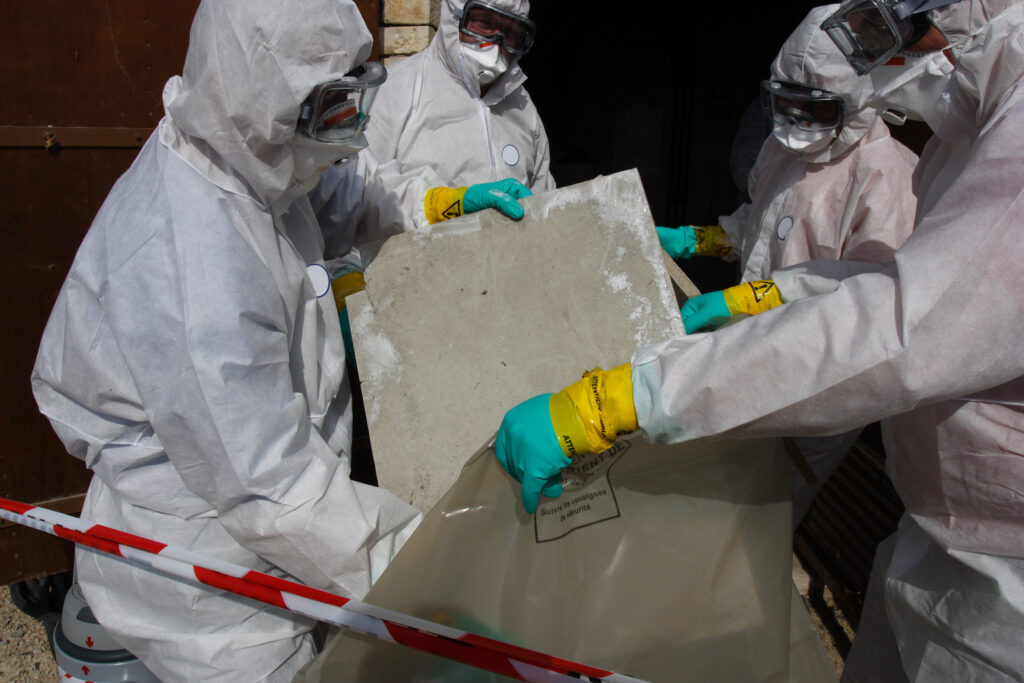
The real danger occurs when these materials are disturbed during renovation, demolition, or maintenance, releasing microscopic fibers into the air. Once airborne, these fibers can be inhaled, and the body cannot break them down or remove them.
Why Legal Advocacy Matters, But Isn’t Enough
Recent federal legal developments, including a pending 2026 court case reviewing EPA asbestos regulations, highlight ongoing efforts to strengthen protections. This federal case is still pending and will influence future asbestos regulation. Regulations alone do not protect workers, training does. Even with stronger laws, workers are still exposed due to lack of awareness, improper handling, and untrained personnel unknowingly putting themselves at risk.
Legal protections set the standard, but education and training enforce it in the real world.
NATEC’s Asbestos Training Programs
At NATEC, the focus is not just on teaching regulations, but on preparing workers to protect lives, including their own.
Our Asbestos Training Programs are designed to support compliance with Cal/OSHA and federal safety standards and provide practical knowledge for working safely around asbestos.
The Bottom Line
Asbestos is not a problem of the past, it is a present-day occupational hazard with lifelong consequences. Asbestos exposure is widely recognized as highly dangerous, with no known safe level of exposure. These diseases are deadly and delayed, but the risks can be significantly reduced with proper training.
- In California, asbestos work is regulated under CAL/OSHA and California Code of Regulations Title 8, including sections §1529 (construction) and §5208 (general industry).
Take action today, protect yourself, your team, and your future by enrolling in NATEC’s Asbestos Training Programs. Because when it comes to asbestos, what you do not know can hurt you years later!