
Understanding OSHA’s Latest Safety Interpretations And How Proper Training Makes Workplaces Safer
On December 10, 2025, the U.S. Department of Labor’s Occupational Safety and Health Administration (OSHA) issued a set of official letters of interpretation designed to clarify how federal safety standards apply in real-world workplace scenarios. These interpretations help employers and safety professionals understand enforcement, compliance, and underlying regulatory intent, particularly for complex requirements such as stairway design and confined space entry practices.
Why These Interpretations Matter
OSHA’s letters aren’t new regulations, they are official guidance explaining how existing standards apply to specific situations. Among the seven clarifications published these were the two topics that are especially relevant to industry and construction safety professionals:
- OSHA Stairway Angle and Tread Depth Requirements
- OSHA Permit-Required Confined Space Entry Practices
Clarifying Stairway Safety and Tread Depth Requirements
One interpretation letter addressed whether specific stair angles and tread depths comply with OSHA’s stairway requirements. Although OSHA’s standards don’t prescribe a specific angle measurement, they do require stairways to have uniform riser heights and tread depths to prevent falls and facilitate safe use.
- OSHA 1910.25 – Stairways.
- The Standards mandate uniform stair riser heights and tread depths for all stairways.
- OSHA’s interpretation confirms that stair design considerations must align with these principles even when unique dimensional variations are proposed.
- CCR Title 8 – §3231. Stairways.
- Stair treads must be reasonably slip-resistant and the nosings shall be of nonslip finish.
- Stair risers, treads, and landing dimensions must be of uniform dimension
- New stairways must comply with required slope parameters and tread sizing under the building code.
- The minimum width, headroom clearance, and landings must meet regulatory performance standards to accommodate safe passage.
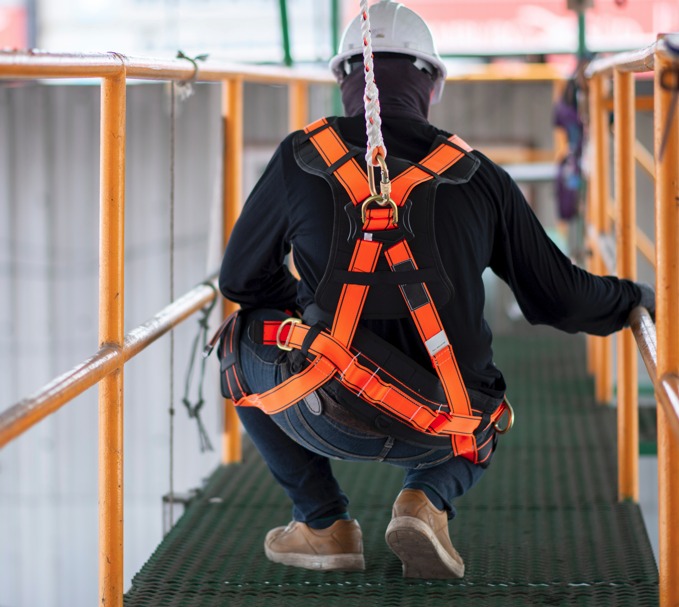
This is also why professional fall protection training like our NATEC International Fall Protection Programs are so crucial. Our programs are designed to give workers and employers the technical knowledge of OSHA’s stairway and fall standards, ensuring compliance and reducing risks on the job site to keep your company reassured that your employee’s are working with safe practices and precautions.
Clarifying Permit-Required Confined Space Entry Practices
Permit-Required Confined Space (PRCS) standards exist to protect workers from hazards that may be present within tanks, vaults, pipelines, silos, basins, and similar enclosed or limited-access environments. Both Federal OSHA and Cal/OSHA establish requirements for hazard assessment, isolation procedures, atmospheric monitoring, and rescue planning before entry is allowed.
These standards outline when employers must complete hazard evaluations, issue entry permits, and ensure proper control of environmental and mechanical energy sources.
- OSHA 1910.146 – Permit-required confined spaces.
- Employers must identify confined spaces and determine whether hazards require permit-required controls.
- Hazardous atmospheres must be tested and verified safe before entry, including oxygen content, flammable gases/vapors, and toxic contaminants.
- An entry permit must document conditions, authorized entrants, emergency services, and monitoring results.
- CCR Title 8 – §5157. Permit-Required Confined Space Entry Practices.
- Requires employers to eliminate or control hazards before entry where feasible
- Requires atmospheric monitoring and continuous evaluation of hazards while workers are inside.
- Mandates written entry programs, defined roles (entrant, attendant, entry supervisor), and rescue procedures.
Working in confined or permit-required spaces involves a higher level of risk due to potential atmospheric hazards, engulfment dangers, mechanical energy, and restricted means of entry and exit. At NATEC our NATEC International Confined Space Trainings are designed to give both workers and supervisors the technical knowledge of proper permitting, hazard assessment, and safe entry practices approved by OSHA.
Staying Ahead Of OSHA’s Expectations
OSHA’s latest expectations and clarifications make one thing abundantly clear: compliance is not a one-and-done exercise, it is an ongoing responsibility that requires proper understanding, preparation, and workforce competence. At NATEC International, our mission is to support employers through high-quality, standards-based training programs that transform complex OSHA and Cal/OSHA requirements into practical, real-world safety practices to keep pushing your businesses forward. So don’t wait and fall behind, stay ahead and on track with our NATEC International Fall Protection Programs and our NATEC International Confined Space Trainings.