
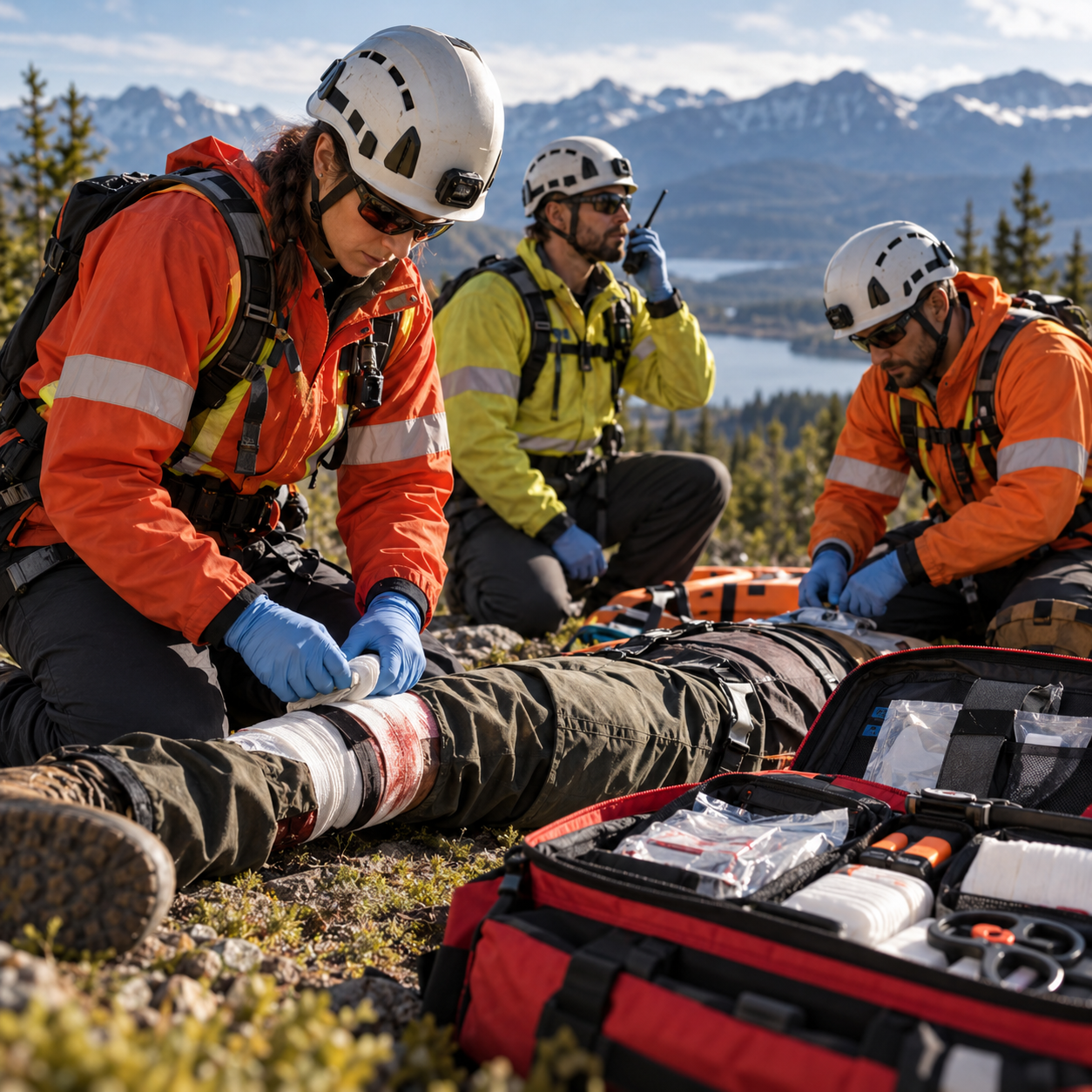
Trauma Response Plan for Remote Workers
Class available at client site only or client-held class at NATEC. Call for pricing.
Description
Class available at client site only or client-held class at NATEC. Call for pricing.
Who This Course is For
- Employees who work in remote areas where emergency medical response is not available in a timely manner
- Designed for hands-on, small-group delivery — recommended maximum 10 students per class
- Recommended refresher frequency: every 2 years
- Pre-requisite: First Aid/CPR/AED trained and current
Course Overview
This course prepares remote-area field crews to respond to medical emergencies before EMS or paramedic assistance can arrive. It combines a review of the client’s own first aid and trauma response procedures with hands-on skills practice using the trauma kit go-bag. Content includes:
- Review of the client’s procedures for first aid and trauma response
- Accurate, timely communication as a top priority during an emergency
- Evaluation and care of an injured worker: assessment and action
- Principles of emergency care
- Response plan development and recommended actions during an injury incident
- Hands-on activities using the supplies in the trauma kit go-bag
- Plan execution and training protocols (drills) for real-life medical emergency scenarios
- Tabletop and functional exercises, including role-play and use of trauma kit supplies
Note: Sections referencing communication, transportation, or procedural steps are built around the client’s own SOPs (e.g., the client’s burn procedure, dispatch/communication protocol, and field transport procedure) and should be customized per client before delivery.
TRAINING AGENDA — One-Day Course
Welcome, Safety Exit Procedures & Introductions
- Safety exit procedures and facility orientation
- Instructor and class introductions
- Course objectives
Exercise: Trauma Kit Go-Bag Familiarization
- Small-group inventory and discussion of Go-Bag / Trauma Kit contents
- Each group selects and presents five items: use, limitations, and who on the crew would use them
Module 1 – Communications: Key Principles
- Importance of clear, concise, timely communication in medical emergencies
- Protocols, role assignment, and communication devices (radios, mobile, backup methods)
- Guiding principles: one designated lead directs and confirms status throughout the response
Module 2 – Client Emergency Communication SOP
- Review of the client’s emergency communication SOP (e.g., burn procedure or equivalent) and required communication sequence
- Initial emergency communications: contacting the client’s dispatch/control center, alternate contacts, 911 use
- Remote work area communications and required information (declaration, location, injury type, assistance needed)
- Client Emergency Communication Flow overview
Practical Exercise: Emergency Communication Scenarios
Groups role-play a simulated emergency call to the client’s dispatch/control center using one of several scenario handouts.
Module 3 – On-Site Evaluation & Care
- Sequence of medical evaluation: CPR, mechanical injury, burns
- Cardiopulmonary status and CAUTION: fall-from-height / suspected spinal injury
- Mechanical injuries: high-voltage muscle contractions, fractures, head injury assessment
- Recognizing and treating shock; ongoing monitoring
Practical Exercise: CPR & AED Refresher
Groups of 4 practice 30:2 compressions and AED use on mannequins (refresher only; all students must be current First Aid/CPR/AED trained).
Module 4 – Choose One Option
Select the option that best fits the class — both lead into the same Burn Victim practical exercise.
Option 1: Thermal / Electrical Burns
- Burn severity (1st, 2nd, 3rd degree) and the Rule of 9’s
- Initial evaluation and thermal burn care for <35% and >35% body surface area
- Electrical burns: recognizing entrance/exit wounds and immediate field care (condensed overview— key recognition points only)
Practical Exercise: Burn Victim Scenario
Groups of 4 assess and treat a simulated burn using only trauma kit go-bag equipment, then communicate the incident per the client’s SOP. Burn Victim Rubric completed and turned in.
Option 2: Wildlife Hazard Awareness w/overview of burn care
- Overview of burn victim care: recognizing burn severity and the basics of initial response (brief overview only)
- Wildlife Hazard Awareness for remote work areas: recognizing and avoiding encounters with coyotes, mountain lions, and other wildlife; general precautions and when to report a sighting
Practical Exercise: Burn Victim Scenario
Groups of 4 assess and treat a simulated burn using only trauma kit go-bag equipment, then communicate the incident per the client’s SOP. Burn Victim Rubric completed and turned in.
Module 5.1 – Heat Illness: Heat Exhaustion & Heat Stroke
- Recognizing heat exhaustion; Cal/OSHA-aligned and client response expectations
- Cooling measures, hydration considerations, and monitoring for improvement
- Heat stroke recognition and immediate care (AHA guidelines): rapid cooling and transport
Module 5.2 – Cold Exposure & Altitude Illness
- Hypothermia: early vs. late signs and immediate care
- Frostbite recognition and first aid
- Acute Mountain Sickness, HAPE, and HACE: recognition and the role of descent
Module 5.3 – Impaled Objects & Amputation
- Impaled object priorities: do not remove, stabilize, control bleeding around the object
- Traumatic amputation: bleeding control, tourniquet use, and care of the severed part
- Trauma kit equipment demonstration: tactical and SWAT-T tourniquets, SAM splint
Hands-On Exercises: Impaled Object Response, Splint Use & Tourniquet Use
Rotating small-group stations practice impaled-object stabilization, SAM splint application, and tourniquet placement using training props.
Module 5.4 – Insect Stings & Snakebites
- Local reaction care and recognizing anaphylaxis
- Epinephrine auto-injector (EpiPen) use
- Snakebite recognition, immediate first aid, and critical do-nots
Hands-On Exercise: EpiPen Trainer Response
Groups of 4 respond to a bee/wasp sting anaphylaxis scenario: stinger removal, EpiPen Trainer use, and emergency call.
Module 5.5 – Suspension Trauma
- Rescue planning for workers at heights; how suspension trauma occurs
- Signs and symptoms; immediate response and rescue deployment
- Post-rescue care: avoiding sudden horizontal or upright positioning; the “W” position
Hands-On Exercise: The “W” Position
Groups assess a simulated suspension trauma victim and place them correctly in the W position while contacting emergency dispatch.
Module 6 – Transportation When Paramedic Services Are Unavailable
- Client field crew procedure for victim transport when EMS is not available
- Maintaining CPR, spinal precautions, and in-route monitoring during transport
Module 7 – Stokes Rescue Device
- Loading the patient: spinal stabilization, positioning, and securing straps
- Unloading the patient: sequence and team coordination
Hands-On Exercise: Stokes Rescue (Class Exercise)
Instructor-guided demonstration followed by student-assisted loading, carrying, and unloading of a simulated injured worker.
Final Integrated Scenarios
- Groups of 4 assigned an integrated trauma scenario from the final scenario handout
- Team Leader assigns Communications Lead and Primary Medical Responder roles
- Full scene assessment, evaluation, and care using trauma kit go-bag supplies only; rubric completed and turned in
Final Exam & Course Closing
- Final written exam
- Course wrap-up and questions
Only logged in customers who have purchased this product may leave a review.
Related Courses
Related products
-
 Southern California Asbestos Operations and Maintenance Class III Refresher CAL/OSHA
-
 Continuing Education Worker CEW (CDPH Lead Worker Refresher) (Spanish) 7 Hour
-
 Southern California Lead Renovation, Repair and Painting Initial
-
 Southern California Asbestos Building Inspector Initial 24 Hour - Per Cal/OSHA Regulations, students are expected to...
Reviews
There are no reviews yet.
Only logged in customers who have purchased this product may leave a review.
Reviews
There are no reviews yet.