
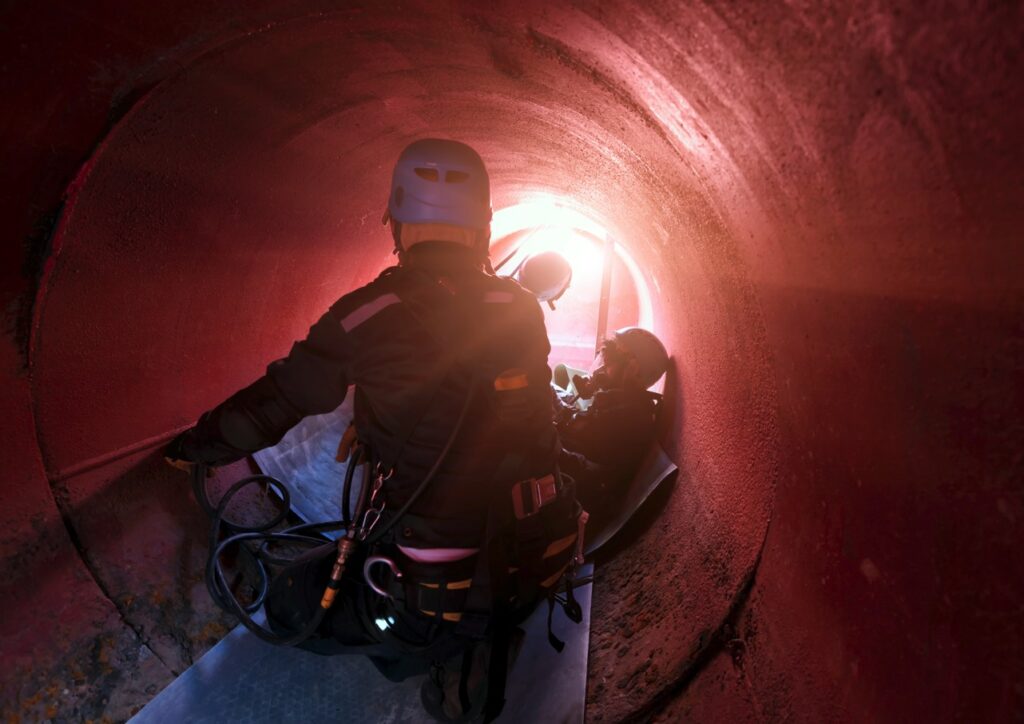
A Chilling Reminder for Confined Spaces: The Consequences of Inadequate Training
On January 16, 2025, OSHA News Release published a news release revealing that at a storm-pipe cleaning/maintenance worksite in Port St. Lucie, Florida, had a horrific preventable incident of a 24-year-old worker that was killed after an inflatable pipe plug exploded. The employer failed to identify and evaluate the hazard of the pressurized plug and develop appropriate procedures. Procedures that are mandatory that workers are supposed to be trained on, in this tragic specific incident, that is performing safe installation and removal of that equipment. While this incident did not occur in California, the lessons are universal, confined spaces and related underground utility operations carry serious hazards. Without appropriate training and procedures, the cost can be as heavy as one’s life. This kind of tragic outcome is exactly what a strong confined‐space training program aims to prevent.
Why Confined Space Training Matters No Matter the State
Clear regulatory basis
- Under Cal/OSHA, in General Industry (Title 8, California Code of Regulations Confined Space Guide for General Industry PDF), a “confined space” is defined by characteristics such as limited means of entry/exit, not designed for continuous occupancy, and in some cases containing or potentially containing a hazardous atmosphere.
- Section 8 CCR §5157. Permit-Required Confined Spaces lays out the requirements for safe entry, including the employer’s duty to evaluate the workplace, notify people of the space’s designation, develop a written permit program, implement procedures for safe entry, and provide training for entrants, attendants, and supervisors.
- Section 8 CCR §5158. Other Confined Space Operations further require that before any employee is permitted to enter a confined space, the employer must implement operating procedures (including rescue procedures) and train employees on those procedures and hazards.
- At the federal level, OSHA’s General Industry Standard § 1910.146 provides similar definitions and mandates regarding permit‐required for confined space programs.
The Stakes Are High
Confined spaces are inherently hazardous and OSHA’s Confined Spaces: Hazards and Solutions highlight those dangers. Confined spaces can often have atmosphere that is oxygen-deficient, toxic or combustible, confined spaces can also contain a serious atmospheric hazard that should be classified as Permit-required confined spaces and should be tested prior to entre. Evaluating hazards and possible solutions related to confined spaces is a necessity for restricted spaces.
A Solid Training Program Is Not an Option It’s a Necessity
Training isn’t just a checkbox to satisfy regulatory bodies. It is the core of preventing incidents. Through training, workers will and need to learn to:
- Recognize what qualifies as a confined space (and permit‐required confined space)
- Understand the hazards they may face, atmospheric, engulfment, entrapment, equipment, etc.
- Know the roles and responsibilities of entrants, attendants, and supervisors
- Understand the permit process, pre-entry testing/monitoring, ventilation, rescue planning
- Use the correct equipment and know rescue contingencies
Without a solid training foundation, even the most thorough written procedures can fall short.
How NATEC International’s Confined Space Training Program Delivers
At NATEC International, we recognize that companies operating in California must not only meet regulatory requirements but also build practical competence in their workforce. Our program, NATEC International Confined Space Training Programs, are designed to deliver:
Comprehensive Curriculum Aligned to Cal/OSHA & OSHA
- Our training covers the definitions, regulatory obligations under Section 8 CCR §5157 & CCR §5158, and Cal/OSHA and federal OSHA standards for work in confined spaces. We emphasize what it means in everyday operations in sewer/storm-water pipes, tanks, vaults, tunnels and more.
Hands On & Scenario Based Learning
- Because confined space hazards are not theoretical, we include scenario-based training (entry/exit, atmospheric monitoring, rescue procedures) so participants experience realistic decision-making and hazard recognition rather than just reading slides.
Tailored for California context
- CCR § 1952 General Requirements require employers to identify confined spaces, prevent unauthorized entry, and ensure workers are properly trained. At NATEC International our confined space training helps teach these core fundamentals while also providing training on hazard recognition, safe entry procedures helping workers stay safe while up to code.
Don’t Be Confined by The Thought of Not Being Prepared
If your organization works with confined or permit-required confined spaces, whether it be tanks, vaults, pipelines, sewers or storm drains then you cannot afford to rely on “we’ll learn on the job” or outdated training. Contact NATEC International today to enroll your team in our Confined Space Training Program Today!